Who is responsible when an AI tool shares false claims?
Short answer.
Responsibility for false AI claims is distributed across model developers, enterprise deployers, and source publishers depending on jurisdiction and operational context. Under emerging legal standards as of 2025, enterprise deployers generally bear primary liability when presenting AI-generated statements to consumers or relying on them in regulated workflows. Model providers face growing scrutiny under product liability and consumer protection laws, while original publishers remain accountable for foundational factual errors in their published content.
Mark Barclay · Published 9/16/2026
Share this article
X and WhatsApp open with the caption already written. LinkedIn and Facebook only accept a link — they build the preview from this page, so copy the caption and paste it into the post.
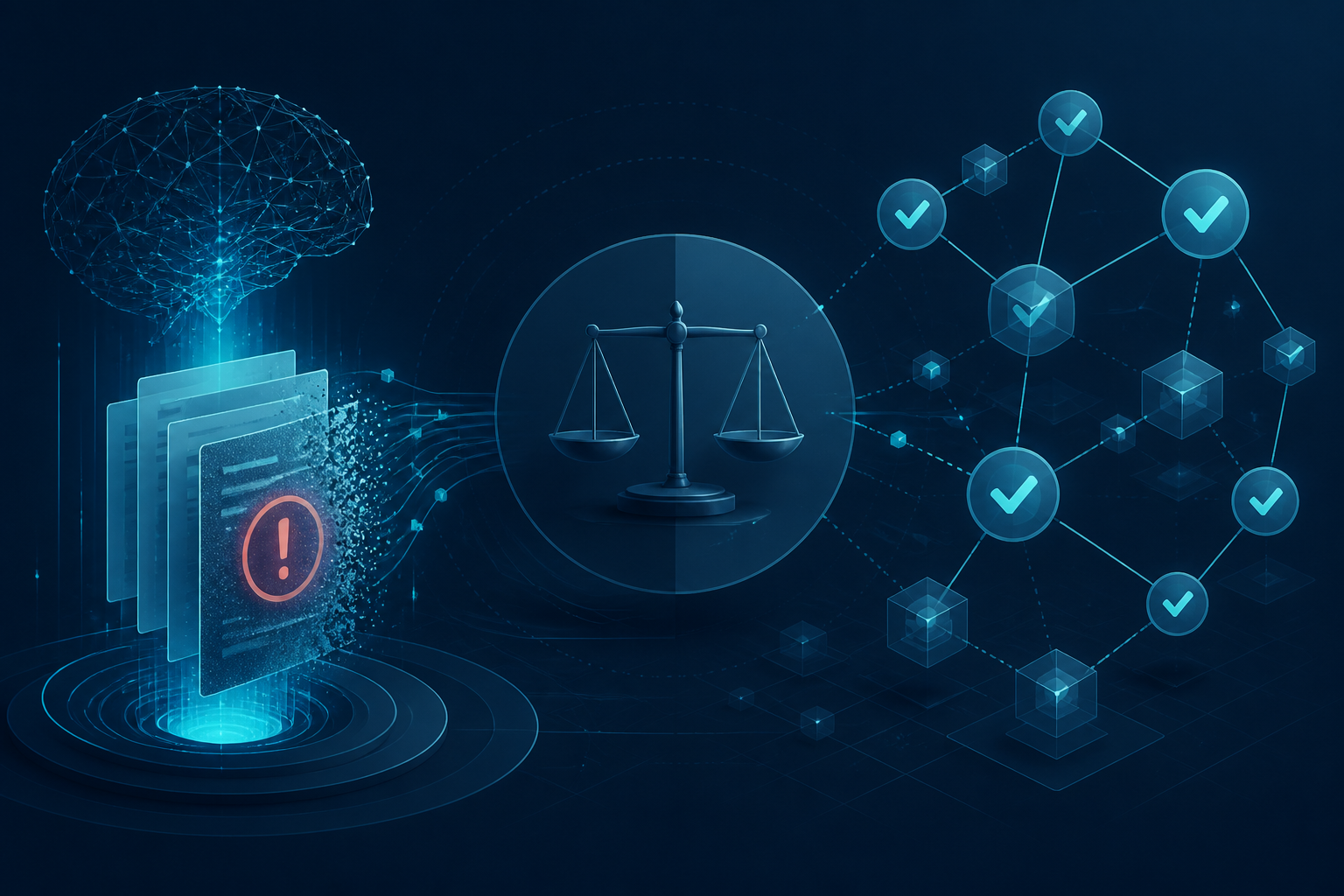
Key takeaways.
- Enterprise deployers usually carry primary legal and commercial liability for the AI outputs they publish or rely upon.
- Model developers face growing scrutiny under consumer protection and product liability frameworks when systems generate systemic falsehoods.
- Traditional intermediary liability protections, such as Section 230 in the United States, face severe tests when applied to generative synthesis.
- Original publishers cannot control downstream generative errors, but maintaining source verification limits misattribution risks.
- Verifiable audit trails and source provenance provide the practical foundation for enterprise regulatory compliance.
How does the law allocate responsibility across the AI supply chain?
Determining who is legally and financially responsible when an artificial intelligence system outputs a false claim is one of the central challenges in contemporary AI regulation. An AI output is rarely the product of a single actor. It involves foundation model developers, fine-tuning engineers, enterprise deployers, retrieval data providers, and end users.
Legal systems traditionally assign liability based on direct conduct, duty of care, and foreseeability. When an AI tool makes a false statement—whether that statement defames a person, gives dangerous medical instructions, or misstates a corporate financial figure—courts and regulatory bodies must determine where the breach of duty occurred.
In general, liability falls across three primary tiers in the AI supply chain:
- Model Developers: The technology firms that train base large language models (LLMs) and set safety filters.
- Enterprise Deployers: The organizations that integrate these models into customer-facing applications, internal workflows, or automated decision engines.
- Source Publishers: The authors and websites whose content was crawled for training data or retrieved at runtime via retrieval-augmented generation (RAG).
[ Base Model Developer ]  -->  [ Enterprise Deployer ]  -->  [ End User / Consumer ]
            ^
            |
  [ Source Publishers & Data Providers ]
Each participant holds different obligations depending on jurisdiction, the nature of the harm, and whether the system operates in a high-risk sector.
What role do AI model developers play in false outputs?
AI developers build the foundational architecture and train models on vast corpora of unstructured web data. When an LLM fabricates facts, developers often argue that generative models are probabilistic text prediction engines rather than deterministic databases. They maintain that hallucinations are inherent to the technology and that disclaimers insulate them from liability.
However, regulators and courts are increasingly skeptical of broad disclaimers. In several jurisdictions, authorities examine whether developers engaged in deceptive business practices by marketing tools as dependable research assistants while knowing they routinely fabricate citations.
Key areas of developer scrutiny include:
- Consumer Protection and Deceptive Practices: If a developer markets a tool for automated research or factual retrieval without disclosing known error rates, consumer protection regulators can penalize the developer for deceptive claims.
- Defamation and Personality Rights: When a model generates false, reputation-damaging statements about living individuals, courts in Europe and Australia have considered whether model developers qualify as publishers under defamation statutes.
- Negligent Design and Product Liability: In jurisdictions considering AI under product liability frameworks, plaintiffs argue that releasing a system known to generate dangerous errors constitutes negligent product design.
Developers attempt to mitigate these exposures by implementing retrieval systems and safety guardrails. When an AI system cites a real webpage to support an invented fact, this creates a citation-to-claim mismatch. In these scenarios, developers may face legal exposure for creating false associations that injure the reputation of referenced third parties.
When are enterprise deployers legally liable for AI errors?
Enterprise deployers—such as law firms, healthcare providers, financial institutions, and e-commerce companies—typically face the highest direct legal liability when AI outputs cause harm. Deployers decide when, where, and how an AI system interacts with clients and internal operations.
If a company deploys an automated customer service agent that misstates pricing or return policies, contract law generally binds the company to the agent's representations. For example, in 2024, a Canadian tribunal held that Air Canada had to honor a discount policy invented by its automated customer service chatbot. The tribunal rejected the airline's defense that the chatbot was a separate legal entity responsible for its own actions.
Deployers carry clear liability in several distinct scenarios:
- Professional Malpractice: When professionals rely on unverified AI outputs—such as attorneys submitting fabricated case citations in court briefs—they violate their ethical duties and procedural rules. The professional, not the AI vendor, carries full disciplinary liability.
- Regulatory Non-Compliance: In heavily regulated sectors like financial advice or clinical diagnostics, deployers must comply with statutory accuracy and disclosure rules. Regulators do not excuse non-compliance on the grounds of automated generation.
- Defamation and Publication: Publishing AI-generated articles containing false assertions makes the publisher legally liable under defamation law once the material is distributed to the public.
To manage this exposure, organizations must implement strong internal controls. Establishing what an AI evidence audit trail should contain allows deployers to prove due diligence and trace errors back to specific system components.
Can intermediary liability shields protect AI platforms?
In the United States, online intermediaries have long relied on Section 230 of the Communications Decency Act of 1996 to shield themselves from liability for third-party content. Section 230 states that interactive computer service providers cannot be treated as the publisher or speaker of information provided by another information content provider.
However, there is growing legal consensus that Section 230 does not broadly shield generative AI outputs. When an LLM synthesizes text, generates summaries, or fabricates new statements, it is creating new content rather than simply hosting or transmitting third-party data.
Legal observers identify two main distinctions:
- Pure Hosting vs. Content Creation: If an AI platform simply searches and displays direct snippets of third-party websites, traditional protections may apply. When the system generates original syntax or draws unsourced inferences, it becomes a content creator.
- Defamatory Synthesis: If an AI tool combines accurate biographical facts about two different people to accuse an innocent person of a crime, the AI provider created that falsehood. Section 230 offers limited protection for content the provider helped develop.
Because intermediary shields are uncertain, enterprises cannot depend on statutory immunity when deploying generative tools.
Do original content publishers share responsibility for downstream AI errors?
Original content creators and online publishers often wonder whether they can be held responsible if an AI crawler ingests their content and distorts it in downstream answers.
As a general legal principle, original publishers are not liable for how third-party AI models misinterpret, truncate, or hallucinate based on their public content. If a publisher writes an accurate medical article, and an AI summarizer misreads the dosage instruction, the publisher bears no legal duty for the AI model's downstream error.
However, publishers face two significant practical consequences:
- Reputational Misattribution: If an AI model hallucinates a dangerous claim and falsely attaches a link to a dependable publisher's domain, users may mistakenly believe the publisher endorsed the claim. Understanding what is citation integrity helps organizations protect their brand from misleading automated associations.
- Compounding Pre-Existing Errors: If an original publisher publishes inaccurate or unverified data, AI systems may ingest and amplify that error across hundreds of downstream queries. While the legal liability for the AI synthesis rests elsewhere, the publisher suffers an erosion of domain dependability.
Publishers that adhere to rigorous evidence standards make it far easier for discovery engines to verify facts correctly and avoid misattributions.
How are global regulatory frameworks approaching AI accountability?
Different jurisdictions are creating distinct statutory regimes to enforce accountability across the AI lifecycle.
The European Union AI Act
The European Union Artificial Intelligence Act, adopted in 2024, establishes a comprehensive, risk-based framework. It places strict obligations on both "providers" (developers) and "deployers" of high-risk AI systems. High-risk systems must maintain detailed technical documentation, log automated events, ensure human oversight, and achieve high levels of accuracy, robustness, and cybersecurity.
Under the EU AI Act, transparency rules mandate that providers of general-purpose AI (GPAI) models disclose their training data summaries and implement safeguards against generating unlawful content. The accompanying proposed AI Liability Directive seeks to ease the burden of proof for victims seeking compensation for damage caused by AI systems.
United States Federal and State Initiatives
In the United States, statutory governance remains sector-specific. The Federal Trade Commission (FTC) uses its authority under Section 5 of the FTC Act to penalize companies that make deceptive claims about AI capabilities or deploy automated tools that cause substantial consumer injury.
Simultaneously, states have introduced legislation addressing automated decision-making and algorithmic discrimination. When tracking where models obtain facts, understanding how do authorities track where AI finds its facts is critical for regulatory audits.
| Stakeholder Tier | Primary Legal Vulnerabilities | Applicable Legal Frameworks | Key Governance Responsibilities |
|---|---|---|---|
| Model Developers | Deceptive marketing, negligent model design, copyright infringement, personality rights violations. | Consumer protection statutes, EU AI Act (GPAI rules), emerging product liability. | Pre-release safety testing, transparency reporting, runtime guardrails, hallucination reduction. |
| Enterprise Deployers | Breach of contract, professional malpractice, statutory non-compliance, direct defamation. | Tort law, contract law, sector-specific regulations (HIPAA, FINRA), EU AI Act (deployer duties). | Human-in-the-loop validation, audit trail logging, user disclosures, retrieval verification. |
| Source Publishers | Brand dilution, misattribution risk, compounding factual errors. | Traditional media and defamation law, copyright law. | Transparent sourcing, structured factual claims, maintaining evidence integrity. |
| End Users / Consumers | Secondary transmission of defamatory or fraudulent claims. | General civil and criminal law (if claims are reused for fraud). | Independent factual verification prior to commercial reliance or public redistribution. |
How can organizations establish verifiable evidence to limit exposure?
Because liability ultimately attaches to whoever asserts or relies upon false information, organizations deploying AI systems must build structured governance processes. Relying on conversational outputs without verification introduces unacceptable operational risk.
To mitigate liability, enterprises should implement five core practices:
- Establish Grounded Retrieval: Use retrieval-augmented generation grounded strictly in dependable, verifiable documentation rather than unconstrained model memory.
- Maintain End-to-End Provenance: Ensure every generated factual claim is linked to its exact source text. This is why ai governance needs source and citation provenance across all deployment stages.
- Implement Human Review for High-Stakes Outputs: Never allow automated systems to publish final legal, clinical, or financial advice without qualified human review.
- Log System Audit Trails: Keep timestamped records of user prompts, model versions, retrieved context, and generated outputs to document compliance during regulatory inquiries.
- Monitor Citation Integrity™ Continuously: Regularly inspect whether retrieval tools cite sources accurately or generate mismatched references that distort original evidence.
By treating AI outputs as draft material requiring systematic verification, organizations can benefit from automation while protecting themselves against legal liability and factual error.
Frequently asked questions
Can a company blame an AI chatbot for giving incorrect advice to a customer?
In most legal jurisdictions, a company cannot avoid liability by blaming an automated tool. If an enterprise deploys a customer-facing chatbot, the company is generally held responsible for the commitments, pricing, or instructions provided by that system.
Does Section 230 protect AI companies from defamation lawsuits?
Section 230 provides strong liability protection for platforms that host third-party content. However, because generative AI models create new text and synthesize statements rather than merely hosting existing content, courts are increasingly finding that Section 230 does not grant blanket immunity for AI-generated falsehoods.
Are human professionals liable if they rely on false AI citations in court or clinical settings?
Yes. Human professionals, such as attorneys, physicians, and financial advisors, carry personal and professional duties of care. Relying on unverified AI citations or advice constitutes professional negligence or malpractice regardless of the tool used.
Can a website owner sue an AI company if a chatbot attributes a false claim to their domain?
If an AI tool fabricates a harmful statement and falsely cites a reputable website as the source, the site owner may have legal claims under trademark dilution, false association, or defamation, depending on jurisdiction and demonstrable harm.
What does the EU AI Act require regarding false or misleading outputs?
The EU AI Act requires providers of general-purpose AI and high-risk AI systems to meet rigorous accuracy, transparency, and cybersecurity benchmarks. Deployers must maintain human oversight, monitor system performance, and keep detailed event logs to track errors.
Sources & evidence
- Article 26: Obligations of Deployers of High-Risk AI Systems
artificialintelligenceact.eu · secondary source
Supports: Deployers of high-risk AI systems shall take appropriate technical and organisational measures to ensure they use such systems in accordance with the instructions for useinstructions for usemeans the information provided by the providerprovidermeans a natural or legal person, public authority, agency or other body that develops an AI system or a general-purpose AI model or ... 2. Deployers shall a
- Artificial Intelligence Risk Management Framework
nvlpubs.nist.gov · secondary source
Supports: 2. Confabulation: The production of confidently stated but erroneous or false content (known colloquially as “hallucinations” or “fabrications”) by which users may be misled or deceived.6 ... “Confabulation” refers to a phenomenon in which GAI systems generate and confidently present erroneous or false content in response to prompts. Confabulations also include generated outputs that ... proced
- Guidelines on transparency obligations for providers and deployers ...
digital-strategy.ec.europa.eu · secondary source
Supports: These guidelines define the scope of transparency obligations for providers and deployers of AI systems under Article 50 of the AI Act. The AI Act follows a risk-based approach, classifying AI systems into four different risk categories, one of which is AI systems posing transparency risks that are subject to the obligations laid down in Article 50 of the AI Act. These transparency obligations app
Part of a cluster
This article supports a pillar guide.
Learn how emerging global rules govern artificial intelligence systems and citations. This plain-English guide explains legal accountability, copyright standards, and steps organizations can take to remain visible and compliant across automated discovery platforms.